What You'll Learn
Making new friends in senior living is possible at any age, even after a loss or a long stretch of quiet days. Friendships can start with something simple, like a regular breakfast table, a walking partner, or someone who loves the same mystery novels you do.
If you're feeling anxious about a potential move and worried about leaving behind everything familiar, you're not alone. Change is hard at any age, and it's completely natural to wonder whether you'll fit in somewhere new.
But here's what research and countless residents tell us: community living creates the exact conditions where friendships form naturally, even when you least expect them.
Is It Really Possible to Make New Friends Later in Life?
"I'm too old to make new friends" is one of the most common things people say when they think about moving to a senior living community. It makes sense. After decades of friendships built through work, raising kids, and neighborhood life, the idea of starting fresh can feel overwhelming.
But sociologists who study friendship have found something important: adults don't lose the ability to form close bonds. What they often lose are the conditions that make friendships happen.
Rebecca G. Adams, a professor of sociology and gerontology at the University of North Carolina at Greensboro, has pointed to three conditions that sociologists have long considered key to forming close friendships: proximity, repeated unplanned interactions, and a setting that lets people let their guard down. Those are the same conditions that made it easy to make friends in school or at work.
When someone lives alone, especially if driving has become difficult or mobility has changed, those three ingredients slowly disappear. Days can pass without a meaningful conversation. A 2020 report from the National Academies of Sciences, Engineering, and Medicine found that more than one-third of adults aged 45 and older feel lonely, and nearly one-fourth of adults 65 and older are considered socially isolated.
If you've been noticing signs of isolation in yourself or a parent, such as fewer phone calls, less interest in going out, or skipping meals, our resource on recognizing when it might be time for assisted living can help you sort through what you're seeing.
How Does Community Living Create Connection?
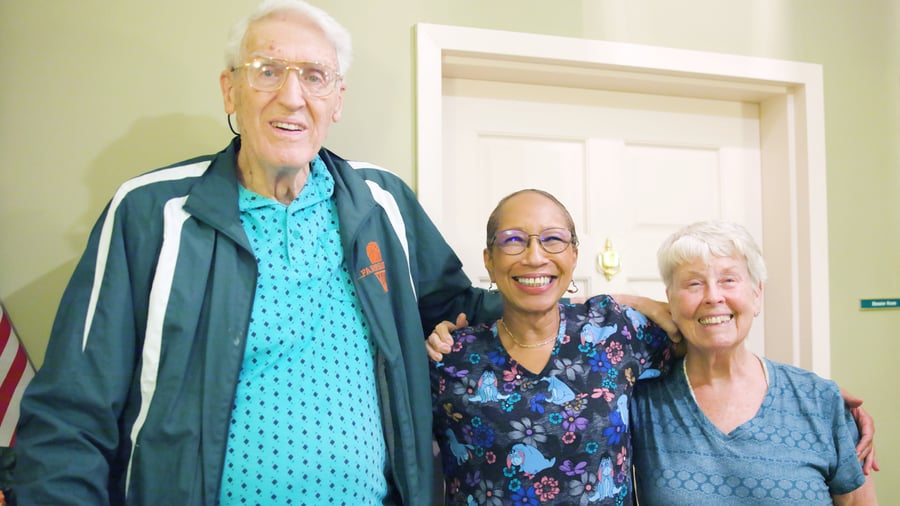
One of the things that surprises people most about senior living in Sandy Springs, GA, is how organically friendships develop. There's no pressure to sign up for every activity or be the life of the party. Connection happens in the small, everyday moments.
You sit next to someone at lunch and discover you both grew up listening to the same radio programs. You see a familiar face at a watercolor class twice a week, and before long, you're saving each other seats. You pass someone in the hallway every morning, and eventually a nod becomes a conversation becomes a friendship.
This isn't accidental. Senior living communities are designed with shared spaces, such as dining areas, gardens, activity areas, and cozy sitting nooks, that encourage exactly the kind of repeated, low-pressure interactions that friendships need to grow.
Compare that to staying alone, where the hours between breakfast and bedtime can stretch out quietly with little human contact. If you're weighing the differences between aging in place and the built-in social life of a community, our guide on senior living vs. staying at home explores this comparison in depth.
What Are Resident Ambassador Programs?
Many communities understand that the first few days and weeks after a move are the most vulnerable. Everything is new: the hallways, the dining schedule, the faces.
That's why many senior living communities have resident ambassador programs. These are current residents who volunteer to welcome newcomers. They might stop by to introduce themselves, invite someone to sit with them at dinner, show them around the library or garden, or simply check in during those first uncertain days.
Having even one friendly connection can transform the experience of moving in from intimidating to manageable. It's the difference between walking into a gathering of strangers and walking in with someone who already knows your name.
These programs exist because the people who live in these communities remember exactly how it felt to be new. They know what it's like to wonder, Will anyone talk to me? Will I belong here? And they want to make sure the answer is yes.
Why Do These Friendships Matter for Your Health?
Friendship isn't just nice to have. It's a health essential.
A landmark study published in PLOS Medicine analyzed data from more than 300,000 people and found that strong social relationships increased the likelihood of survival by 50 percent. That's a stronger effect than quitting smoking, and comparable to well-known risk factors like obesity and physical inactivity.
For seniors, the health benefits of friendship are especially significant. The Harvard Study of Adult Development, one of the longest-running studies on human happiness, found that the quality of a person's relationships was the single strongest predictor of health and well-being in later life. Not wealth, not fame, not even genetics. Relationships.
In a community setting, friendships provide more than companionship. They provide motivation to stay active: a reason to show up to the exercise class, try a new hobby, or take a walk outside. Shared activities like art classes, fitness groups, and book clubs don't just fill the calendar. They create the kind of active, engaged lifestyle that fuels both physical health and social connection.
For those exploring memory care in Sandy Springs, GA, social engagement is equally important. Meaningful interaction, even brief, warm exchanges, can help reduce agitation and improve quality of life for people living with dementia.
How Can You Find Your People in a New Place?
You don't have to be outgoing to make friends in senior living. You don't have to join every club or attend every event. Some of the deepest friendships form between people who simply enjoy sitting together in comfortable silence, sharing a cup of coffee on the porch, or working on a puzzle side by side.
The beauty of community living is that it removes the barriers that make friendship so difficult later in life, such as transportation challenges, limited mobility, and the quiet isolation of an empty house, and replaces them with opportunity. Not forced togetherness, but gentle, natural chances to connect.
If you're considering senior living near Dunwoody, Buckhead, Roswell, Brookhaven, or anywhere in North Atlanta, know that the friendships waiting for you may be the most unexpected and most rewarding part of the experience.
What's the Next Step?
Feeling uncertain about a move is completely normal, and no one should rush you. But if loneliness has become a quiet companion, if the days feel a little too long and the house a little too empty, it may be worth exploring what life in a community could look like.
We'd love to answer your questions or simply have a conversation about what matters most to you. Download our guide, Senior Living Demystified, to learn more about what daily life in a community really looks like, and reach out whenever you're ready.