

You've been carrying a mental list for weeks, maybe months. Medication schedules. Missed meals. That phone call where your parent sounded a little too quiet. You're researching personal care communities near Warrington, PA, and you have a solid grasp on care levels, pricing ranges, and what questions to ask on a tour. But there's one thing the fact sheets can't give you: a feel for what an ordinary Tuesday looks like for someone who actually lives there.
That's what this post is for. Not the highlights reel, but the unhurried rhythm of a day in personal care. Because once you can picture it, the decision starts to feel less overwhelming.
If you're still weighing whether your parent needs more support, here are some signs to look for.
Getting Ready: Support Without Hovering
One of the most common worries families have is that personal care will feel institutional, with a rigid schedule imposed on someone who has spent decades living on their own terms. The reality in most quality communities is quite different.
Mornings in personal care typically start when the resident is ready. There's no 6 a.m. wake-up bell. If your parent likes to sleep until 8:30, that's fine. If they're an early riser who wants coffee at dawn, staff can accommodate that too.
What does change is the struggle. If your parent needs help with buttons, zippers, or getting in and out of the shower safely, a trained caregiver is available, not standing over them, but nearby and ready. That kind of consistent, quiet support is what separates assisted living from simply living alone and hoping for the best.
For families in the Bucks County, PA area, this is often the detail that shifts the conversation. It's not about taking independence away. It's about removing the obstacles that have been chipping away at it.
Meals: Reliable Nutrition and a Reason to Leave the Apartment
Think about your parent's eating habits right now. Are they cooking balanced meals? Or are they relying on toast, canned soup, and whatever's easiest to reach?
In personal care, meals are prepared daily by kitchen staff, with menus that rotate and account for dietary needs. But here's the part that surprises many families: mealtimes often become one of the most enjoyable parts of the day. They're social. Residents sit together, have conversations, and build the kind of casual friendships that become hard to maintain when you're living alone.
Breakfast might be served in a dining area between 7:30 and 9 a.m., with options ranging from eggs and fruit to oatmeal and pastries. Lunch and dinner follow a similar model, structured enough to provide consistency but flexible enough that residents have choices.
For someone who's been skipping meals or eating the same thing every day, this shift alone can make a visible difference in energy, weight, and mood within weeks.
Between Meals: How the Hours Actually Fill Up
This is the part that's hardest to picture from the outside. What does someone do all day in personal care?
The honest answer: it depends on the person. And that's the point.
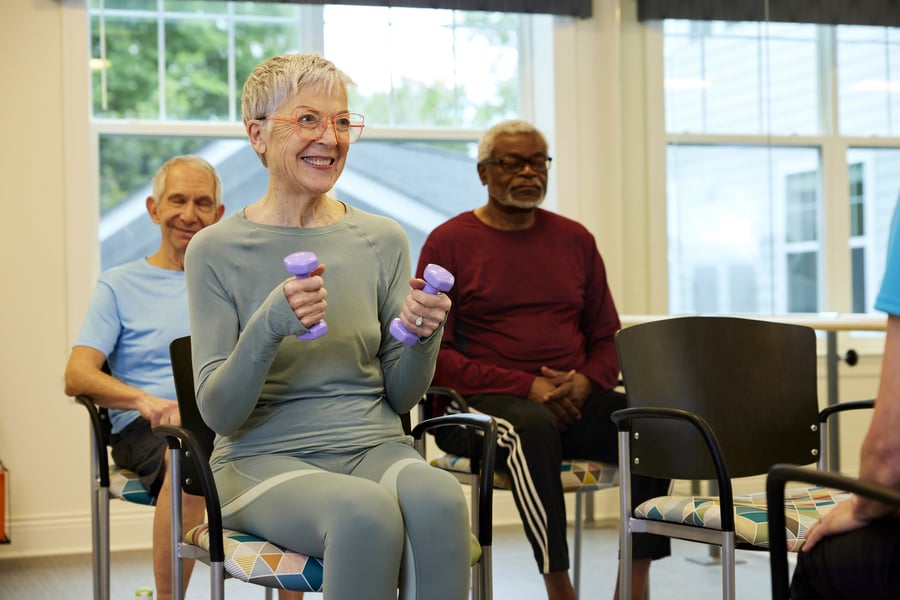
Most communities offer a daily calendar of activities, from exercise classes and art groups to card games, live music, book clubs, gardening, and outings to local spots. In the Doylestown and Warrington area, that might mean trips to nearby parks, local shops, or community events.
But participation is never mandatory. Some residents fill their afternoons with activities. Others prefer to read in a quiet corner, call family, or simply sit outside and enjoy the weather.
The key difference from living alone is that the option is always there. Isolation, one of the most serious health risks for older adults, becomes much less likely when there are people around and things to do, even on a low-key day.
If your parent is living with memory loss, communities offering memory care near Chalfont, PA, or Doylestown, PA, often provide more structured programming designed to support cognitive engagement. Activities may be simpler and more sensory-focused, but the goal is the same: purpose, connection, and comfort.
The Safety Net You Won't See: Medication and Health Coordination
This is often the piece that tips the scales for families. If you've been managing your parent's medications remotely, calling to remind them, sorting pill organizers on weekend visits, worrying about missed doses, you already know how exhausting and unreliable that system can be.
In personal care, medication management is handled by trained staff. Doses are tracked, administered on schedule, and documented. If something changes, such as a new prescription, a reaction, or a refusal, the care team communicates with physicians and family members promptly.
Beyond medication, there's a broader layer of coordinated care happening throughout the day. Staff monitor changes in behavior, appetite, mobility, and mood. They notice things that a weekly phone call simply can't catch. For families exploring personal care options in Warrington, PA, or memory care near Jamison, PA, this kind of consistent oversight is often the strongest argument for community-based care over staying alone.
Many families reach this decision after realizing that caregiving has become unsustainable. Here's how to know when that moment has arrived.
Evenings: Winding Down Without Worry
Dinner is typically served between 5 and 6:30 p.m. After that, the pace of the community slows naturally. Some residents watch a favorite show in a common area. Others head back to their apartment to relax privately. Staff remain available for help with evening routines, such as changing clothes, brushing teeth, and getting into bed safely.
For many families, this is the part that brings the most relief. No more lying awake at 11 p.m. wondering if your parent remembered to lock the door or whether they got up in the middle of the night and fell. In assisted living, someone is always there, not intrusively, but reliably.
Residents often personalize their space with familiar furniture, photos, and belongings, which makes the transition feel less abrupt and more gradual. You can learn more about what daily life looks like and how residents settle in.
What Changes for You
Here's something worth naming: when your parent moves into personal care, your life changes too. The midnight worry calls, the pharmacy runs, the constant mental math of "are they okay?" Those don't disappear entirely, but they do ease. You get to go back to being a family member instead of a full-time care coordinator.
That shift matters. It's not selfish to want it. It's sustainable.
If you're exploring options for senior living in Bucks County, PA, whether that's personal care in Warrington, Alzheimer's care near Buckingham, or memory care in Southampton, PA, knowing what a typical day looks like can help you ask better questions on tours and feel more confident in your decision.
Ready to take the next step? For a deeper dive into what personal care includes, from care levels to costs, download our free Complete Guide to Personal Care. It's a straightforward resource designed to help you compare your options with clarity.



.jpg?width=1500&height=1941&name=DOY-Everything%20You%20Need%20to%20Know%20About%20The%20Solana%20Doylestown1%20(1).jpg)