If someone told you there was a single factor that could reduce the risk of dementia by 38%, lower the chance of depression by 27%, and improve overall survival odds by 50%, would you expect it to come in a bottle? Require surgery? Need a prescription?
It doesn't. It comes from something deceptively simple: social connection.
For families in Lake Worth, FL, and surrounding communities like Lantana, Greenacres, and Boynton Beach, the conversation about a parent's health usually starts with the visible markers: medications, mobility, doctor visits. But a growing body of research suggests that who your loved one spends time with, and how often, may be just as critical as any clinical intervention.
Let's look at what the data actually says and what it might mean for your family.
What Does the Research Say About Social Wellness and Aging?
Over the past decade, healthy aging research has shifted in a significant direction. Scientists and healthcare leaders are now measuring social wellness alongside traditional health metrics, and the findings are hard to ignore.
According to research supported by industry experts including the VP of Engagement at The Arbor Company, Brandi Blizzard, and compiled in a comprehensive report by LifeLoop:
-
Strong social relationships are associated with a 50% greater likelihood of survival. That's a staggering number, larger than the effect of many common medical treatments.
-
Social connection is linked to a 38% reduced risk of dementia, a finding with particular relevance for families concerned about cognitive decline.
-
Higher social connectedness is associated with an 18% reduced risk of anxiety and a 27% reduced risk of depression.
These aren't soft, feel-good statistics. They're clinical outcomes. And they point to a conclusion that researchers are growing increasingly confident about: social wellness isn't a nice addition to healthcare. It's foundational to it.
Why Is Isolation Among Older Adults So Dangerous?
If connection is so protective, what happens when it disappears?
Unfortunately, isolation among older adults is far more common than most people realize. Nearly 24% of adults age 65 and older are socially isolated, and 43% of adults over 60 report feeling lonely. That's not a small subset. It's a significant portion of the aging population, including many people living right here in Palm Beach County.
And isolation doesn't just feel bad. It causes measurable harm. Researchers have compared the health impact of social isolation to smoking up to 15 cigarettes a day. Isolation increases mortality risk by 29%. Loneliness increases it by 26%. Living alone pushes it even higher, up by 32%.
What makes this particularly difficult for families is how quietly it develops. A parent living alone in Lake Worth or Palm Springs might seem fine on the surface. They answer the phone, they say they're eating well, they insist nothing has changed. But the slow erosion of daily social contact can happen over months or years, often without anyone noticing until the effects become visible: a new diagnosis of depression, a fall that seems to come out of nowhere, or a noticeable decline in cognitive sharpness.
If you've been watching a parent gradually withdraw, skipping activities they used to enjoy, spending more days without leaving the house, or seeming less engaged during conversations, you may be seeing the early signs of this kind of quiet disconnection.
Why Does Connection Require Design, Not Just Proximity?
One of the most important insights from social wellness research is this: being around other people isn't the same as being connected to them.
A person can live in a busy household and still feel lonely. They can attend a weekly event and never form a meaningful relationship. What the research consistently shows is that purposeful, repeated, varied social engagement is what drives outcomes, not just physical proximity to other humans.
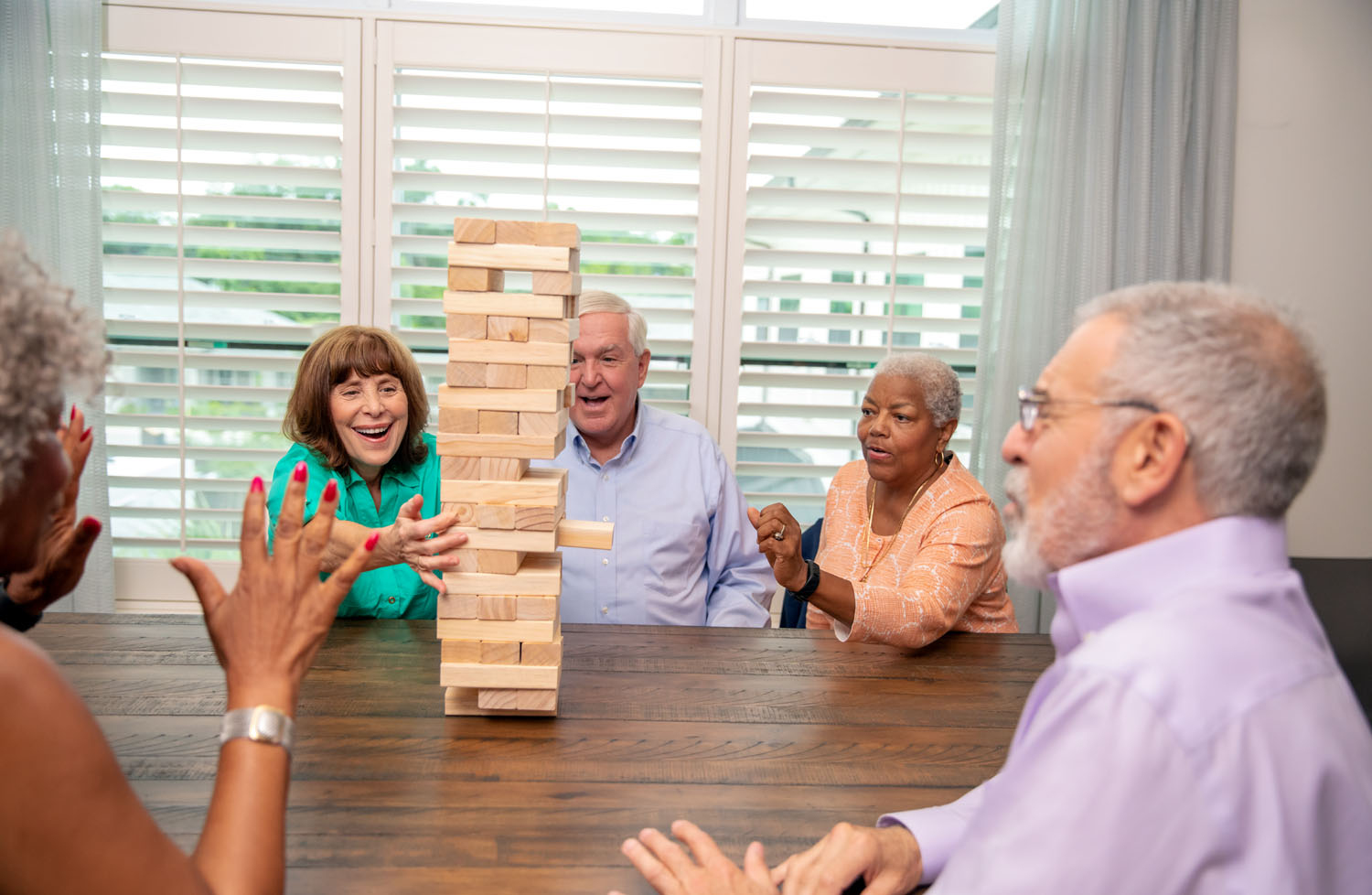
This is where the distinction between passive and intentional programming becomes critical. Turning on a television in a common room is not social programming. But a structured discussion group, a shared art project, or a cooking class that brings people together around a task are the kinds of interactions that build genuine connection. They require planning, consistency, and an understanding of how daily engagement supports emotional wellness in senior living.
This applies across every level of care, from independent living to assisted living to memory care. A person living with dementia benefits from connection just as much as someone living independently. The type of engagement may look different, but the underlying need is the same.
How Are Senior Living Communities Addressing Social Wellness?
Here's what often surprises families: the infrastructure for social wellness already exists in well-run senior living communities. It's not theoretical. It's happening every day in dining areas, activity spaces, gardens, and hallways.
Communities that take social wellness seriously don't leave connection to chance. They build it into the weekly schedule with intention and variety. Whether it's a fitness class, a book club, an intergenerational event, or a simple morning coffee gathering, every touchpoint is designed to create opportunities for meaningful interaction. Curious about what that actually looks like on a day-to-day basis? See what purposeful daily programming actually looks like in a senior living community.
This kind of programming also doesn't exist in a vacuum. The best communities embed social connection within a broader holistic wellness framework that includes physical activity, nutrition, cognitive engagement, and emotional support. Social wellness becomes one thread in a larger fabric, not an afterthought tacked on at the end.
For families in Lake Worth, Atlantis, Hypoluxo, Lake Clarke Shores, and across Palm Beach County, this research offers a useful lens for evaluating care options. When you visit a community, look beyond the physical space. Ask about the programming calendar. Ask how staff members encourage participation without forcing it. Ask whether the approach changes for people with different needs or abilities.
These are the questions that reveal whether a community treats connection as infrastructure or as an amenity.
What Can Your Family Do Right Now?
You don't need to have all the answers today. But if you've noticed a parent becoming more isolated, eating alone most nights, turning down invitations, or seeming less like themselves, this research validates what you may already feel in your gut: something important is missing.
Social wellness and aging are deeply intertwined. The evidence is not ambiguous. Connection protects cognitive function, supports emotional health, and extends life. And the absence of connection does the opposite.
The good news is that this isn't a problem without solutions. Whether your family is exploring independent living, assisted living, or memory care, communities across South Florida are already built around the principles this research supports.
Want to explore the full picture of healthy aging, including how physical activity, nutrition, and social connection work together? Download our free guide to vibrant, active aging for practical ideas your family can use right now.