

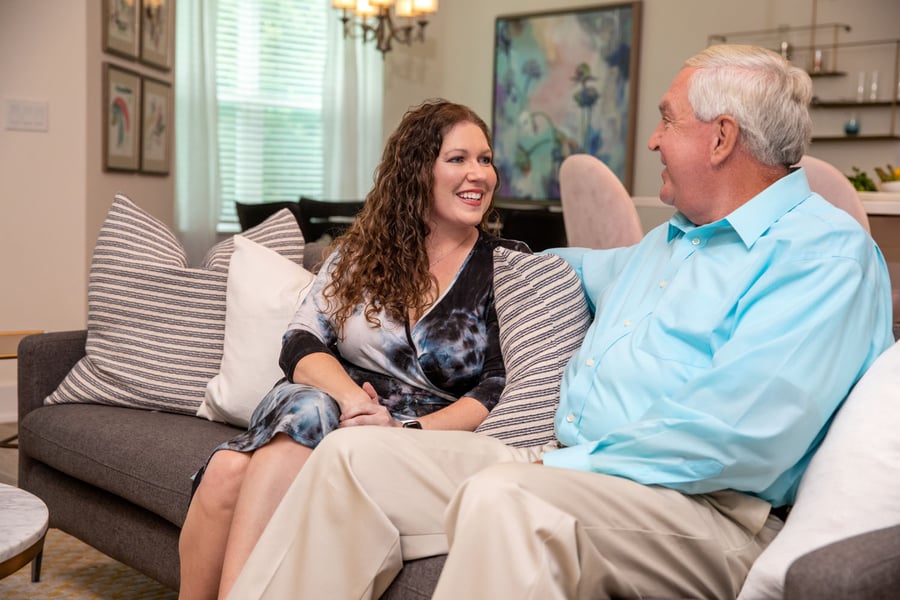
Maybe you're the one who always organized the family holidays. The one who remembers everyone's doctor appointments. The one people call when something needs to get done. So it's no surprise that when your parent started needing more help, the responsibility landed on your shoulders.
But this conversation about assisted living feels different from coordinating a family dinner. It feels enormous. And if you're a family caregiver in the Dacula or Hamilton Mill area searching for answers, you're not alone. Thousands of adult children face this exact moment, and most of them feel the same mix of love, worry, and guilt that you do right now.
The good news: there are ways to approach this talk that honor your parent's dignity and your own emotions. Let's walk through them.
Name What You're Feeling Before You Start
Before you sit down with your parent, sit down with yourself. The guilt many caregivers carry can quietly shape the entire conversation. If you walk in already feeling like you're doing something wrong, your parent will pick up on that energy.
So let's reframe this: researching senior living options in Dacula, GA, isn't a sign of failure. It's a sign that you want your parent to have more support than one person can provide. There's a difference between abandoning someone and making sure they're surrounded by trained, attentive people every day.
Write down your reasons, not to present as evidence, but to ground yourself. Maybe you've noticed missed medications, a kitchen that's no longer being used, or increasing isolation now that driving feels unsafe. If you're still sorting out whether now is the right time, our guide on 10 signs your parent could benefit from assisted living can help you clarify what you're seeing.
Knowing your "why" isn't about building a case. It's about speaking from a place of clarity rather than anxiety.
Choose the Setting as Carefully as the Words
Timing and environment matter more than most people realize. A conversation squeezed in between errands, or brought up during a holiday gathering with the whole family watching, almost always backfires.
Instead, choose a moment when:
-
It's just the two of you (or the two of you plus one trusted family member).
-
Your parent is rested and comfortable, not during a health scare or right after a fall.
-
You aren't rushed, so there's space for silence, questions, and emotion.
For families spread across Gwinnett County and the surrounding areas, including Lawrenceville, Suwanee, Buford, and Sugar Hill, these conversations sometimes happen over the phone. That's okay. What matters is that your parent feels heard, not cornered.
A weekday afternoon visit, a quiet lunch at their kitchen table, or even a walk outside can set the right tone. The goal is to create a space that says, "I'm here to listen," not "I've already made a decision."
Scripts That Sound Like You, Not a Brochure
One of the hardest parts is knowing what to actually say. Here are a few conversation starters you can adapt to your own voice and relationship:
If your parent values independence:
"Mom, I've been thinking about how we can make sure you keep doing the things you love without worrying about the stuff that's gotten harder. Can we talk about what that might look like?"
If you've noticed specific safety concerns:
"Dad, I noticed [specific thing, like the stove left on, a bruise from a fall, or expired food in the fridge], and it scared me. I want to figure out a plan together so I'm not just worrying from a distance."
If your parent has mentioned loneliness:
"You've said a few times that the days feel long. I've been looking into some communities near Dacula that have a lot of social activities and people your age. Would you be open to learning about them with me?"
Notice what these scripts have in common: they're invitations, not ultimatums. They center your parent's experience and open a door rather than push through one.
When Your Parent Says "I'm Not Going Anywhere"
Resistance is normal. Expected, even. Your parent may respond with anger, tears, silence, or a firm "no." That doesn't mean the conversation failed.
Here's how to handle common pushback:
"I want to stay in my home." This is usually about control and familiarity, two things that feel threatened by change. Acknowledge that: "I understand. Your home means everything to you. Can we at least look at what options exist, so we're not making decisions in a crisis?" If your parent's main concern is wanting to stay where they are, it can help to look at the comparison together. Our guide on staying at home vs. moving to senior living lays out the pros and cons honestly.
"I don't need help." Avoid arguing about what they can or can't do. Instead, try: "I know you're managing a lot on your own, and I'm proud of that. I just want to make sure we have a plan so things don't get harder suddenly."
"You're trying to get rid of me." This one stings. Take a breath. Then try: "That's the last thing I want. I'm bringing this up because I love you and I want to see you thriving, not just getting by."
After any of these responses, give your parent space. This is rarely a one-time conversation. It's a series of smaller talks that build understanding over time.
What Happens After the Talk
If your parent is open to exploring options, even reluctantly, the next step is making it tangible. Abstract ideas are easy to resist. A warm dining area, a friendly face at the front door, or a calendar full of activities is much harder to dismiss.
At Arbor Terrace Hamilton Mill in Dacula, GA, families often tell us that visiting in person changed everything. Their parent walked in expecting a clinical setting and found a community where people laughed over coffee, staff knew residents by name, and the pace of life felt comfortable, not institutional. Families across Gwinnett County, from Flowery Branch to Duluth, find the right fit for their parent's specific needs.
The approach at Arbor Terrace Hamilton Mill focuses on coordinated care that's tailored to each resident. That means your parent isn't adapting to a rigid system; the community adapts to them. It's one reason families in Auburn, Braselton, Hoschton, and Winder choose Arbor Terrace Hamilton Mill: the care feels personal because it is.
If your parent does say yes, it helps to know what the transition actually looks like. Here's what to expect in your parent's first month at senior living.
You're Doing the Right Thing
Having this conversation doesn't make you a bad family member. It makes you a brave one. The fact that you're researching, reading, and preparing shows exactly how much your parent's wellbeing matters to you.
For a more comprehensive guide with additional conversation starters and planning steps, download our free guide on talking to your parent about senior living.