
You're not in crisis mode. Nobody's been rushed to the hospital, and your parent is still managing most of their day just fine. But lately, small things have started to add up: missed medications, a fridge full of expired food, or a hesitation at the top of the stairs that wasn't there before. So you start researching. And within ten minutes, you're drowning in terms: assisted living, skilled nursing, nursing homes, long-term care. They all blur together.
You're not alone. Many family caregivers struggle to distinguish between types of senior care. The confusion isn't a sign that you haven't done enough homework. It's a sign that the senior care landscape genuinely needs better explanation.
This guide will walk you through the core differences between assisted living and nursing homes so you can file this knowledge away for whenever you need it. If you want an even deeper dive, our free Senior Living Demystified guide breaks down all the options in plain language.
What Problem Does Each One Solve?
The simplest way to think about it: assisted living helps people who need support with everyday tasks. Nursing homes help people who need ongoing medical care.
Assisted living is designed for older adults who are largely independent but could use a hand with certain daily activities, such as bathing, dressing, medication reminders, or meal preparation. The goal is to provide just enough help so residents can continue living with dignity, autonomy, and a sense of routine. Many communities near Fulton, MD, and the broader Howard County area offer assisted living alongside memory care for people living with Alzheimer's disease or other forms of dementia.
Nursing homes (also called skilled nursing facilities) serve a different population. Residents typically need round-the-clock medical supervision, including wound care, IV therapy, physical rehabilitation after surgery, or management of complex chronic conditions. Licensed nurses and physicians are on-site or on-call at all times, and the level of clinical oversight is significantly higher.
Here's a quick way to frame it: if your parent needs help living, assisted living is likely the right fit. If your parent needs help healing or managing a serious medical condition, a nursing home may be more appropriate.
How Does the Day-to-Day Experience Differ?
This is where the two options really diverge, and where many families are surprised.
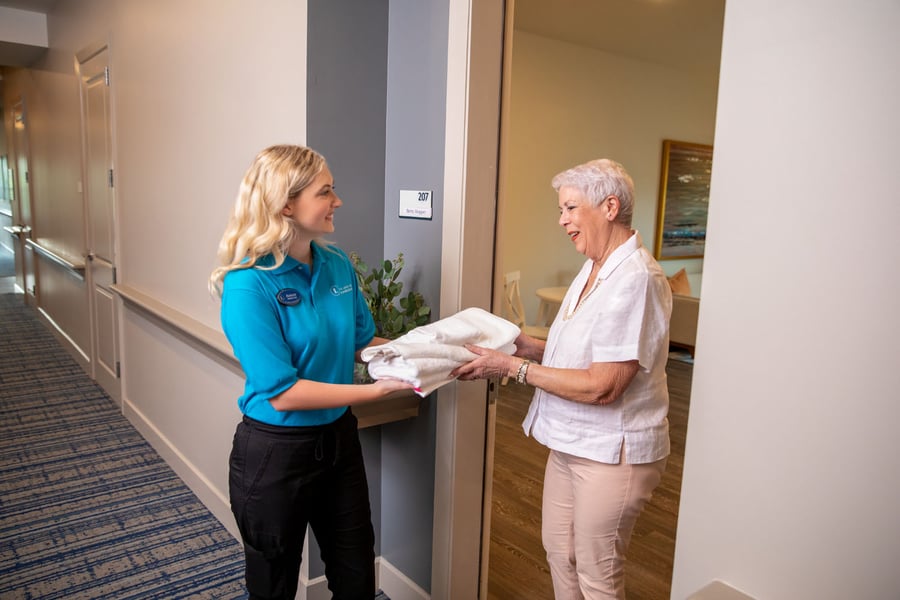
Assisted living communities are built to feel residential. Think private or semi-private apartments, shared dining areas, activity calendars packed with social events, fitness classes, and outings. Residents come and go from their apartments, eat meals with neighbors, and have the freedom to shape their own schedules. See what a typical day in assisted living actually looks like to get a clearer picture.
Nursing homes, by contrast, are structured around medical needs. The environment is more clinical: shared rooms are common, meals follow a set schedule, and daily routines often revolve around treatments, therapy sessions, and health monitoring. Staff-to-resident ratios are higher because the care demands are greater.
Neither setting is inherently better or worse. They simply serve different needs. For a parent who's still socially active and physically mobile but struggling with a few daily tasks, the structured medical environment of a nursing home could feel unnecessarily restrictive. On the other hand, for a parent recovering from a hip replacement or managing a feeding tube, assisted living wouldn't have the clinical resources to keep them safe.
How Do the Costs Break Down?
Cost is often one of the first questions families ask, and the answer depends heavily on the type and level of care involved.
Assisted living is typically paid for through private funds, long-term care insurance, or veterans' benefits. Medicare generally does not cover it.
Nursing home care generally costs significantly more than assisted living. Medicaid does cover nursing home care for those who qualify, which is a major factor for many families. Medicare may also cover short-term skilled nursing stays (such as rehabilitation after a hospital stay), though it does not cover long-term custodial care.
Understanding how to pay for either option can feel overwhelming. Learn more about how families in Fulton pay for senior living to explore your options in more detail.
How Do You Figure Out Which Option Fits?
There's no single checklist that works for every family, but asking a few honest questions can help you narrow things down:
-
Can your parent handle most daily activities with just a little help? If they mainly need assistance with bathing, dressing, or medication management but can otherwise get around and engage in conversation, assisted living is likely the right level of care.
-
Does your parent require regular medical procedures or skilled nursing? If they need wound care, injections, catheter management, or constant monitoring for a complex condition, a nursing home is better equipped.
-
Is cognitive decline a factor? Many assisted living communities offer specialized memory care neighborhoods for people living with dementia. These provide a secure, structured environment with trained staff, without the full clinical intensity of a nursing home. Families in the Fulton and Howard County area will find memory care options designed specifically for this need.
-
What does your parent want? This matters more than families sometimes realize. A parent who values independence and social connection may thrive in assisted living. A parent who feels anxious without close medical oversight may feel more secure in a skilled nursing setting.
If you're trying to gauge whether your parent might benefit from assisted living specifically, download our free guide to the 10 signs your parent could benefit from assisted living. It's a practical resource you can revisit whenever the time feels right.
There's No Rush, but Knowledge Helps
You may be months or even years away from making any decisions about a parent's care. That's perfectly fine. The families who feel most confident when the time comes are usually the ones who started learning early, not because they were in a hurry, but because understanding their options took the panic out of the process.
The difference between assisted living and a nursing home comes down to the kind of support your parent needs. One offers help with daily life in a residential setting. The other provides intensive medical care. Both have a place, and knowing which is which puts you ahead.
If you'd like to keep exploring, you can explore the full range of senior care options available in Fulton, MD or get our Complete Guide to Assisted Living for a deeper look at what to expect. Both are free and designed to help you feel informed, on your own timeline.