

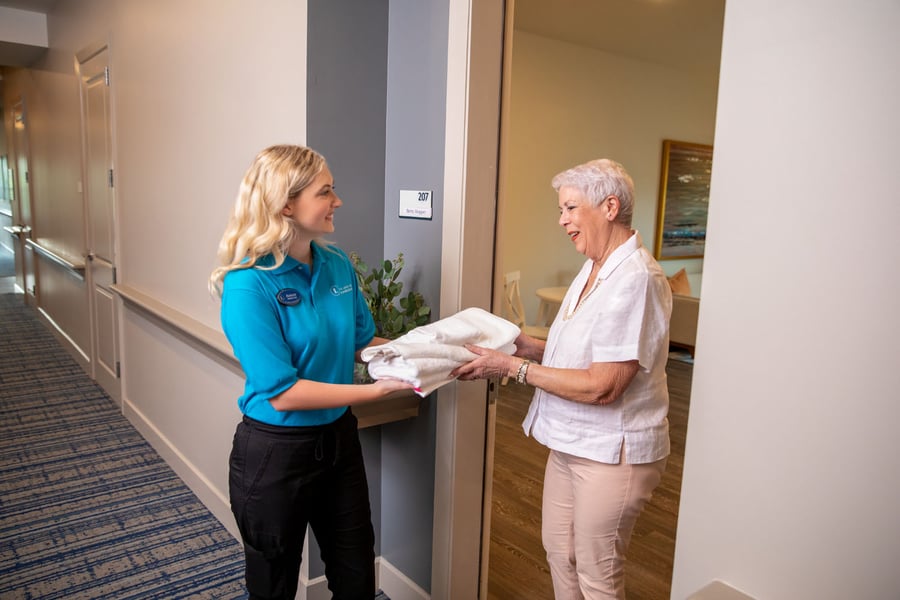
Imagine your parent mentions they almost fell in the kitchen last week, or you notice prescription bottles piling up on the counter, some expired, some unopened. Nothing is urgent yet, but a quiet worry starts building. You open your laptop and start searching, and suddenly two terms keep appearing: "assisted living" and "nursing home." They sound similar, but they're actually quite different.
If you're a family member in the Miami area beginning to think about what the future might look like for an aging parent, understanding this distinction now can save you stress, money, and guilt down the road. Making this decision before a crisis forces a fast choice puts you in control. Let's break it down clearly.
What Are the Two Main Models of Senior Care?
The simplest way to think about it: assisted living is designed around lifestyle with support, while a skilled nursing facility (sometimes called a nursing home) is designed around medical care with housing.
In assisted living, residents typically have their own apartment. They receive help with daily activities like bathing, dressing, medication management, and meals, but they maintain a high degree of independence. There are social activities, communal dining, and an emphasis on keeping life engaging and comfortable.
A skilled nursing facility, by contrast, provides around-the-clock medical supervision. Residents often share spaces and have access to licensed nurses and physicians on-site at all times. These communities serve people recovering from surgery, managing complex chronic conditions, or needing a level of medical attention that goes beyond what assisted living can offer.
Neither option is "better" in the abstract. The right choice depends entirely on what your loved one needs.
What Does Daily Life Look Like in Each Setting?
One of the biggest misconceptions is that assisted living communities feel institutional. For most families in areas like Coral Gables, Coconut Grove, or Kendall, visiting an assisted living community for the first time is a pleasant surprise. Residents decorate their own spaces, come and go with freedom, join fitness classes or book clubs, and eat meals in restaurant-style dining areas.
Skilled nursing facilities have a different rhythm. Because residents need more intensive medical care, the environment is structured around clinical schedules: medication rounds, physical therapy sessions, and regular monitoring by nursing staff. Social activities exist, but the primary focus is health management and recovery.
How Do Costs Compare in Miami?
Cost is often one of the first questions families ask, and it's an important one. In Florida, the average monthly cost of assisted living tends to be significantly lower than a skilled nursing facility because the level of medical staffing and equipment differs.
The median monthly cost of assisted living in Florida is generally lower than a semi-private space in a skilled nursing facility. These numbers vary across Miami-Dade County.
It's also worth knowing how payment works:
-
Assisted living is most often paid through private funds, long-term care insurance, or veterans' benefits. Medicaid coverage for assisted living in Florida is limited but growing.
-
Skilled nursing facilities are more commonly covered by Medicare (for short-term rehab stays) and Medicaid (for long-term care when assets are depleted).
Transparency around pricing matters. When you're evaluating any community, ask exactly what's included in the monthly rate and what triggers additional charges. Hidden fees are one of the most common frustrations families report.
For a broader look at all the senior care options available in Miami, see our Family Guide to Senior Care Options.
How Do You Know Which Option Fits Your Parent?
This is where many families feel stuck. Your parent may need some help but not round-the-clock nursing. Or perhaps cognitive changes, like early-stage memory loss, are adding a layer of complexity. Miami-area families dealing with mild cognitive impairment or early-stage dementia support needs often find that assisted living communities with specialized memory care programs offer the right balance of safety and quality of life.
Here are some guiding questions:
Assisted living may be the right fit if your parent:
-
Needs help with a few daily tasks (bathing, medication reminders, meals).
-
Is generally medically stable.
-
Would benefit from social engagement and structured activities.
-
Wants to maintain independence in a comfortable setting.
-
Is experiencing early cognitive changes that benefit from supportive routines.
A skilled nursing facility may be more appropriate if your parent:
-
Requires daily skilled nursing care (wound care, IV therapy, ventilator support).
-
Is recovering from a major surgery or hospitalization.
-
Has advanced medical needs that can't be managed outside a clinical setting.
-
Needs 24/7 monitoring by licensed medical professionals.
Not sure if your parent's needs point to assisted living or something more? These 10 signs can help you decide.
Why Does Planning Ahead Give You Better Options?
When families are forced to choose a care setting during a hospital discharge or after a fall, the decision feels overwhelming and rushed. Researching the differences now, even if your parent is still relatively independent, puts you in a much stronger position.
Start by having honest conversations with your parent about their preferences. Tour a few communities when there's no pressure. Talk to your parent's physician about what level of care makes sense both now and in the foreseeable future. And if you're part of Miami's large bilingual community, know that resources are available in Spanish as well. A Spanish-language guide comparing independent living, assisted living, and memory care is available for families who prefer it.
The fact that you're reading this article now, before anything is urgent, says a lot about how much you care. That early awareness is one of the most valuable gifts you can give your family.
Whenever you're ready to learn more about senior living options in the Miami area, download our Complete Guide to Assisted Living. It's a great next step for families who are just starting to explore what's available.