

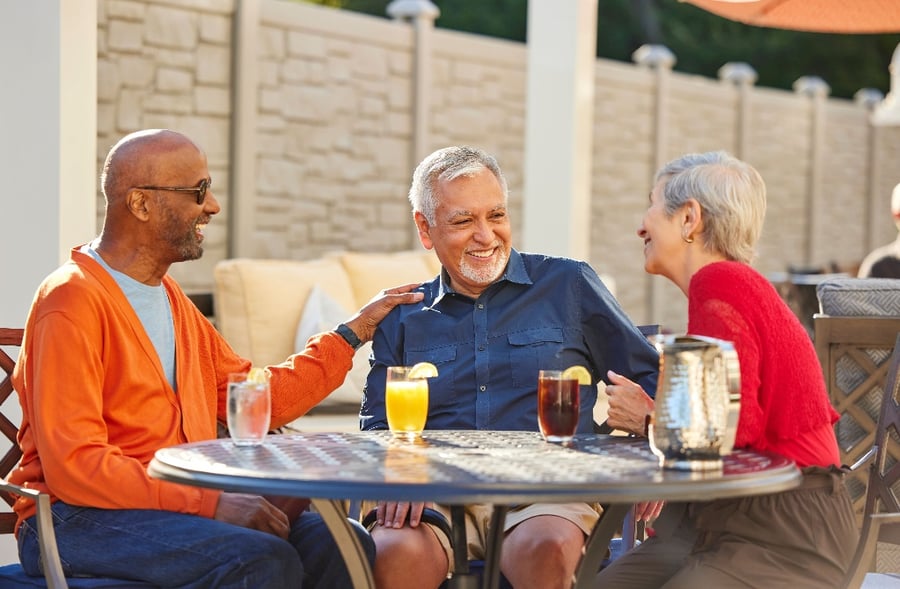
Let's talk about something that probably isn't on your parent's medical chart.
Not their blood pressure. Not their cholesterol. Not even their latest bone density scan. We're talking about how often they sit across the table from another person. How many conversations they have in a week. Whether anyone expects them somewhere tomorrow.
These may sound like soft, feel-good concerns. But a growing body of research says they carry the weight of hard medical facts, and families in the Basking Ridge area and beyond should be paying attention.
What Does the Research Say About Social Connection and Health?
According to research supported by industry experts including The Arbor Company's VP of Engagement, Brandi Blizzard, the data connecting social wellness and aging to measurable health outcomes is no longer preliminary. It's substantial.
A comprehensive report from LifeLoop compiles findings that reframe how we should think about connection:
-
Strong social relationships are associated with a 50 percent greater likelihood of survival. That's a number that rivals the impact of quitting smoking or starting an exercise program.
-
Social connection is linked to a 38 percent reduced risk of dementia, a statistic that should matter deeply to anyone exploring cognitive support for a loved one.
-
Higher social connectedness is associated with a 27 percent reduced risk of depression and an 18 percent reduced risk of anxiety.
These are not small numbers. And they point to something important: social wellness isn't an add-on to healthcare. It belongs at the center of the conversation about healthy aging. Developing daily habits that support emotional health is one way families can begin acting on this research right now.
How Widespread Is Social Isolation Among Older Adults?
Here's the other side of the equation, and it's harder to look at.
Nearly 24 percent of adults age 65 and older are socially isolated. That's roughly one in four. And 43 percent of adults over 60 report feeling lonely.
Those numbers describe a widespread problem, but they can still feel abstract. So consider what isolation looks like on a Tuesday afternoon in Somerset County: an older adult eating lunch alone, watching television for the fifth straight hour, and realizing they haven't spoken to anyone in two days.
Researchers have compared the health impact of social isolation to smoking up to 15 cigarettes a day. Living alone, something many older adults in communities from Bernardsville to Bridgewater do after losing a spouse, increases mortality risk by 32 percent. If you've started to notice your parent spending more time alone, it may be worth learning about signs that a parent shouldn't live alone.
This isn't about blame. Many older adults end up isolated gradually. A friend moves away, driving becomes more difficult, a spouse passes. The social fabric thins one thread at a time, and by the time families notice, the health consequences may already be compounding.
Why Does Connection Need Structure, Not Just Proximity?
One common assumption is that being around other people solves the problem. It doesn't, at least not on its own.
Think about it this way: you can sit in a crowded coffee shop and still feel completely alone. Proximity creates the possibility of connection, but it doesn't guarantee it. For older adults, especially those navigating hearing loss, mobility challenges, grief, or cognitive changes, walking into a room full of strangers can feel more isolating than staying put.
This is why the conversation about social wellness has shifted from "Do people have activities?" to "Are those activities designed to create meaningful connection?"
The distinction matters enormously. A bingo game where people sit side by side without interacting is not the same as a small-group discussion where someone shares a memory and another person responds. A fitness class where a person living with dementia can participate alongside others is different from one that excludes them.
Across the senior living field, social wellness is increasingly measured the way fall risk or medication adherence is measured. It's becoming a tracked outcome, not just a programming line item. Investing in holistic wellness programs is one way to build the kind of structure that turns daily life into a series of genuine touchpoints.
How Do Senior Living Communities Support Social Wellness?
What the LifeLoop research makes clear, and what families sometimes overlook, is that senior living communities function as social wellness infrastructure.
Think about what a well-run community provides: shared meals with the same group of people each day, programming that brings residents together around shared interests, staff members who know each person's name and story, and a physical environment designed to encourage spontaneous interaction. These aren't luxuries. They're the building blocks of the kind of connectedness that research says extends lives and protects cognitive function.
This applies across every level of care. Connection needs to be woven into the fabric of each day, not offered as an optional extra.
What Should Families Do With This Information?
If you're reading this, there's probably a reason. Maybe your parent in the Basking Ridge or Martinsville area has been turning down invitations. Maybe the phone calls have gotten shorter. Maybe the house is fine, the medications are managed, and everything looks okay, except for a nagging feeling that something is missing.
Trust that feeling. The research validates it.
You don't have to have all the answers right now. But you can start by recognizing that social wellness isn't a nice-to-have. It's a health priority. And you can begin exploring what options exist to build more connection into your loved one's life.
For families weighing whether a loved one would benefit from the built-in social structure of a community, our free guide compares staying at home versus moving to senior living. It's a good place to start making sense of what comes next.