What You'll Learn
You've already done so much research that your browser has more tabs open than you can count. You've compared communities in Exton, Malvern, West Chester, and Downingtown. You've talked with your parent's doctor. And somewhere along the way, you realized this decision isn't just about where your parent will live. It's about matching the right level of care to exactly where they are right now.
If your parent is living with early- or mid-stage dementia, the choice between personal care and memory care can feel especially high-stakes. Both offer support, but they're designed for very different needs. This guide breaks down the key differences so you and your family can move forward with clarity.
What Does Personal Care Cover, and Who Is It Built For?
Personal care communities in Chester County provide daily support with activities like bathing, dressing, medication management, and meals. Residents typically live in private or semi-private apartments and have access to social programming, dining, housekeeping, and transportation.
For many older adults, personal care is the right fit, especially for someone who needs hands-on help but can still navigate their day with some independence. If your family has been comparing in-home care to personal care in Exton, you already know that a personal care community offers something that in-home aides often can't: built-in socialization, consistent staff oversight, and a structured environment.
However, personal care communities are not specifically designed for cognitive decline. Residents generally move freely through the community, choose how to spend their time, and follow a flexible daily schedule. That independence is a strength, unless your parent's dementia has progressed to a point where it creates safety risks.
How Is Memory Care Structured Differently, and Why?
Memory care isn't just personal care with a few extra features. It's a fundamentally different model of support, built from the ground up for people living with Alzheimer's disease and other forms of dementia.
Here's what that looks like in practice:
-
Secured environment. Memory care neighborhoods are designed so that residents cannot wander outside unsupervised. This is one of the most important distinctions for families whose parent has started leaving the house at odd hours or getting disoriented in familiar places.
-
Higher staff-to-resident ratios. Memory care communities typically have more team members per resident, and those team members receive specialized training in dementia communication, redirection techniques, and behavioral support.
-
Structured daily programming. Rather than offering a menu of optional activities, memory care programs use research-backed engagement strategies designed to reduce agitation, promote connection, and support cognitive function throughout the day.
-
Sensory-informed design. Hallways, common areas, and even lighting are designed to minimize confusion. Color-coded pathways, visual cues, and calming spaces all help residents feel oriented and safe.
For a closer look at what these features mean for your family, our guide to choosing memory care walks through what to ask during tours and what to look for in a community.
What Drives the Cost Difference Between Personal Care and Memory Care?
Memory care typically costs more than personal care, and the difference isn't arbitrary. It reflects the added infrastructure, staffing, and specialized programming that memory care requires.
According to Genworth's 2023 Cost of Care Survey, the national median cost for memory care runs roughly 20–30 percent higher than personal care. In the Chester County area, including communities near Paoli, West Chester, and Downingtown, that difference can range from a few hundred to more than a thousand dollars per month, depending on the community and level of care.
Understanding this breakdown helps families compare apples to apples. For detailed pricing context in the Exton area, see our guide on what families should expect to pay for senior living in Exton.
You can also compare your Alzheimer's and dementia care options side by side with our free downloadable resource.
How Do You Know Which Level of Care Your Parent Needs Right Now?
This is the question that keeps families up at night. And the honest answer is: it depends on where your parent is today, not where they were six months ago.
Personal care may be the right fit if your parent:
-
Has a mild cognitive impairment or early-stage dementia diagnosis.
-
Can follow a general daily routine with prompts and reminders.
-
Doesn't wander or become disoriented in familiar settings.
-
Benefits from social interaction and light structure.
-
Needs help with daily tasks but not constant supervision.
Memory care may be the better choice if your parent:
-
Has wandered or attempted to leave their current community.
-
Becomes agitated or confused during transitions (sundowning, for example).
-
Needs help with most activities of daily living, including eating and toileting.
-
No longer recognizes familiar people or places consistently.
-
Has had safety incidents, such as falls, medication errors, or getting lost.
If you're unsure where your parent falls on this spectrum, use our dementia care checklist to evaluate your loved one's needs. It's a practical tool that can help you organize your observations and share them with your family or your parent's care team.
What Does Arbor Terrace Exton Offer Families in Chester County?
At Arbor Terrace Exton, we offer personal care, memory care, and a transitional program for residents whose needs fall somewhere in between. This means your parent doesn't have to move to a different community if their needs change over time.
Our memory care neighborhood features the research-backed programming, higher staffing levels, and secured environment described above. And residents in personal care benefit from coordinated care, engaging social programming, and a team that knows them by name.
We understand that this decision involves your whole family, from siblings weighing in from out of state to a spouse managing their own health concerns. That's why we encourage families in Exton, West Chester, Malvern, and throughout Chester County to visit, ask hard questions, and take the time they need.
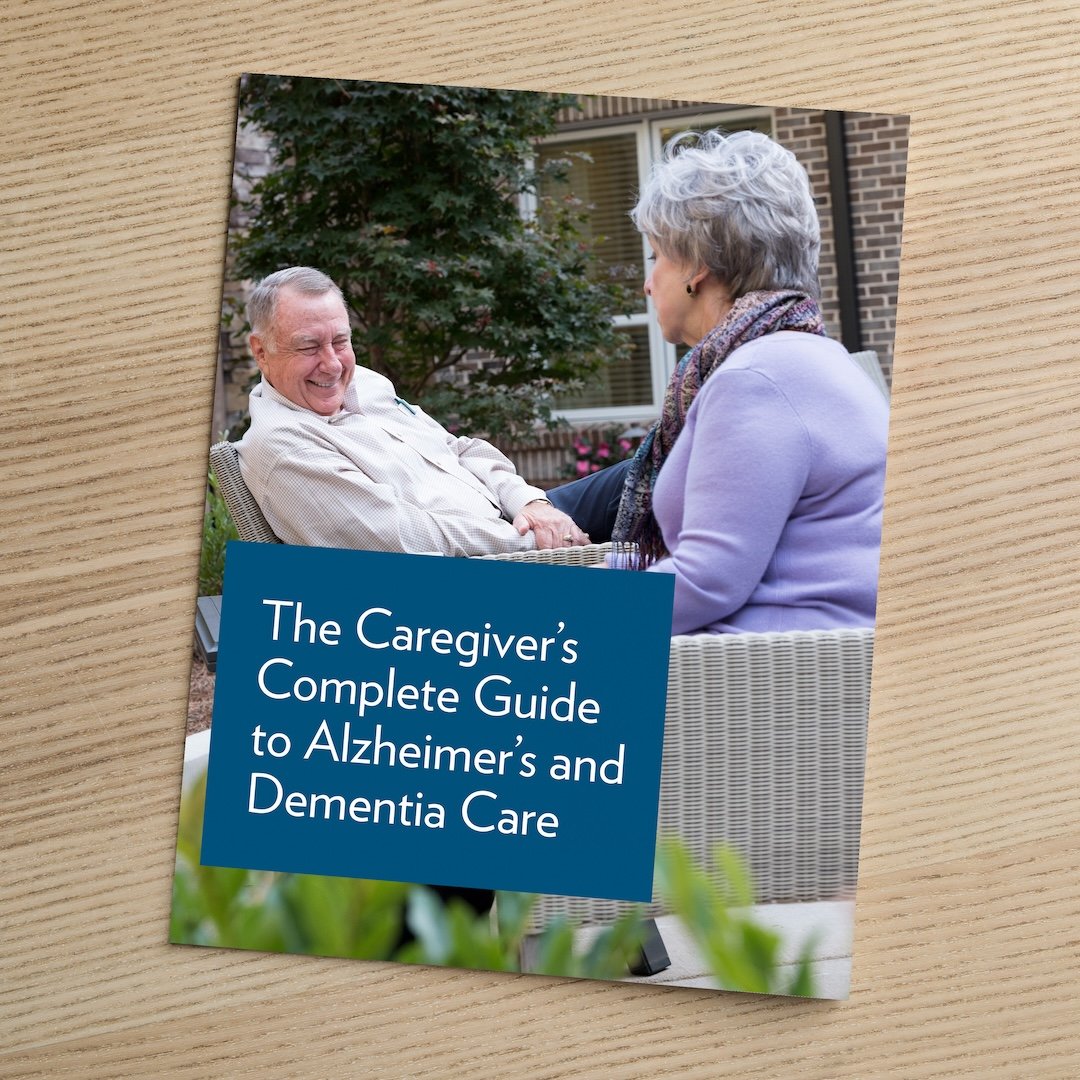
Ready to take a next step? Schedule a conversation or tour at Arbor Terrace Exton, or download our free Caregiver's Complete Guide to Alzheimer's and Dementia Care for a deeper look at supporting a loved one with dementia. We're here whenever your family is ready.